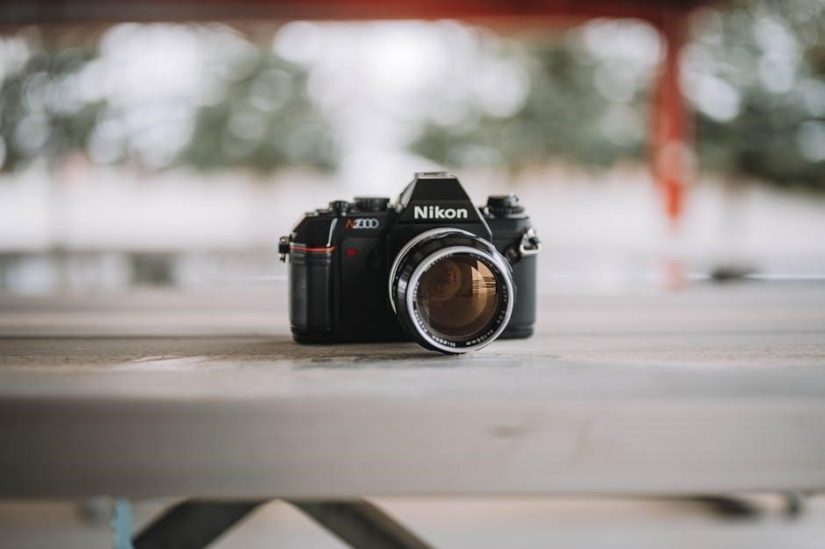
Nikon F100 Instruction Manual: A Comprehensive Guide
Today, March 31st, 2026, at 6:12:12 PM, this manual serves as a reliable companion for safely operating and maintaining your Nikon F100 camera.

Welcome to the world of professional photography with the Nikon F100! This robust and reliable 35mm film SLR, as of today, March 31st, 2026, remains a favorite among enthusiasts and professionals alike. This instruction manual is designed to guide you through every aspect of the camera’s operation, ensuring you unlock its full potential.
The F100 blends advanced technology with intuitive controls, offering a versatile platform for capturing stunning images. Whether you’re a seasoned photographer or just beginning your journey, this guide will provide clear, concise instructions. It’s a dependable tool, and this manual will help you maintain it effectively, as indicated by support resources available today.
Key Features and Specifications
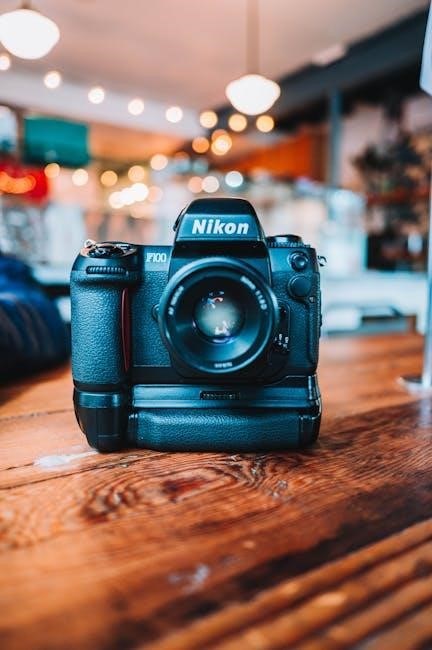
The Nikon F100, documented as of March 31st, 2026, boasts a sophisticated autofocus system with five AF points, ensuring sharp and accurate focus. It features a robust electronic shutter, providing speeds from 30 seconds to 1/4000th of a second. Its advanced Matrix metering system delivers consistently accurate exposures in diverse lighting conditions.

This camera supports various exposure modes – Programmed Auto, Aperture-Priority, Shutter-Priority, and Manual – offering creative control. It accommodates DX-coded and non-DX-coded films, and features a built-in intervalometer for time-lapse photography. Reliability and performance are key, as highlighted by ongoing user support today.

Understanding the Camera Body
As of March 31st, 2026, the Nikon F100’s body is constructed for durability and comfortable handling. Its ergonomic design places essential controls within easy reach, facilitating intuitive operation. The camera’s build prioritizes a secure grip, even in challenging conditions. A comprehensive layout ensures smooth transitions between settings.
The top deck houses the shutter speed dial, exposure mode selector, and ISO setting. The rear panel features controls for film advance, rewind, and LCD display. Understanding these placements is crucial for efficient use, supported by reliable user guidance available today. This robust design ensures long-term usability.
Front and Rear Views – Component Identification
Examining the Nikon F100 as of March 31st, 2026, the front reveals the lens mount, self-timer button, and depth-of-field preview lever. The rear showcases the film door release, rewind crank, and LCD panel displaying crucial shooting information. Identifying these components is fundamental for operation.
Further inspection reveals the viewfinder, diopter adjustment, and various buttons controlling autofocus and metering modes. The rear also houses the battery chamber and memory card slot. Familiarizing yourself with each element, guided by reliable documentation, ensures optimal performance and a seamless photographic experience. This detailed layout promotes efficient workflow.
Top and Bottom Views – Control Layout
As of March 31st, 2026, the Nikon F100’s top panel features the main command dial for selecting shooting modes (P, A, S, M), shutter release button, and ISO setting dial. The film advance lever and rewind crank are also prominently positioned for efficient film handling. Understanding their placement is key to smooth operation.
The bottom view reveals the battery compartment and tripod socket. Careful attention to these areas ensures secure mounting and reliable power. The control layout is ergonomically designed for intuitive access, allowing photographers to quickly adjust settings without interrupting the creative process. This thoughtful design enhances usability.
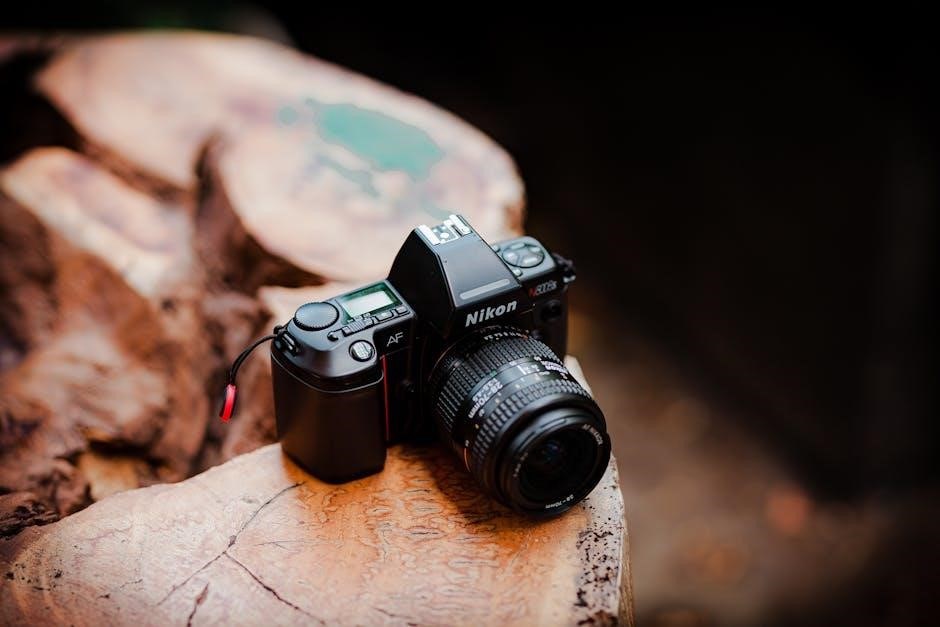
Loading Film and Batteries
As of March 31st, 2026, preparing your Nikon F100 begins with correctly loading film. Ensure the camera back is opened and follow the designated film path, carefully threading the film leader to the take-up spool. Proper loading prevents jams and ensures accurate exposures throughout your shooting session.
Battery installation is equally crucial. The F100 utilizes standard batteries, inserted into the compartment located on the camera’s bottom. Confirm correct polarity before closing the door securely. Reliable power is essential for all camera functions, so always use fresh batteries for optimal performance and avoid interruptions during important moments.
Film Loading Procedure – Step-by-Step
As of March 31st, 2026, begin by opening the camera back using the film release lever. Insert the film cassette into the film chamber, ensuring it clicks into place. Gently pull the film leader across the camera body and thread it onto the take-up spool.
Advance the film using the rewind crank until the film leader is securely gripped by the spool’s teeth. Close the camera back firmly. Press the shutter release button a few times to advance the film past the exposed leader. The frame counter will indicate the first usable frame. Always double-check for proper film advancement before shooting!
Battery Installation and Types
As of March 31st, 2026, the Nikon F100 utilizes 2CR5 lithium batteries for power. To install, locate the battery compartment on the camera’s bottom. Slide open the compartment cover and insert the batteries, observing the correct polarity (+ and -) markings inside. Ensure the batteries click securely into place.
The F100’s battery indicator will display the remaining power level. Low battery warnings indicate the need for replacement. Using genuine Nikon batteries or high-quality alternatives is recommended for optimal performance. Avoid mixing old and new batteries. Proper battery handling ensures reliable camera operation and prevents potential damage.
Exposure Modes Explained
As of March 31st, 2026, the Nikon F100 offers versatile exposure control. Programmed Auto (P) selects both aperture and shutter speed automatically, ideal for general shooting. Aperture-Priority (A) lets you choose the aperture, influencing depth of field, while the camera sets the shutter speed.
Shutter-Priority (S) allows you to control shutter speed, freezing or blurring motion, with the camera adjusting the aperture. Manual (M) grants full control over both aperture and shutter speed, perfect for challenging lighting or creative effects. Understanding these modes empowers photographers to achieve desired results consistently.
Programmed Auto Exposure (P)

As of March 31st, 2026, the Nikon F100’s Programmed Auto Exposure (P) mode offers a convenient, all-purpose shooting experience. The camera intelligently selects both the aperture and shutter speed based on the current lighting conditions, aiming for a well-exposed photograph. This mode is exceptionally useful for everyday photography when quick results are desired without manual adjustments.
While the camera handles the technical settings, photographers can still utilize exposure compensation to fine-tune brightness. Programmed Auto is a great starting point for beginners and a reliable option for experienced users seeking simplicity.
Aperture-Priority Auto Exposure (A)
On March 31st, 2026, utilizing the Nikon F100’s Aperture-Priority Auto Exposure (A) mode grants photographers creative control over depth of field. You, the user, select the desired aperture (f-stop), influencing how much of the image is in focus, while the camera automatically determines the appropriate shutter speed for correct exposure.
A wider aperture (lower f-number) creates a shallow depth of field, ideal for isolating subjects, while a narrower aperture (higher f-number) yields greater depth of field, suitable for landscapes. Exposure compensation remains available for fine-tuning, offering a balance between automation and artistic intent.
Shutter-Priority Auto Exposure (S)
As of March 31st, 2026, the Nikon F100’s Shutter-Priority Auto Exposure (S) mode empowers photographers to control motion blur and freeze action. In this mode, you set the desired shutter speed, and the camera automatically adjusts the aperture to achieve proper exposure. Faster shutter speeds freeze motion, perfect for sports or wildlife, while slower speeds create motion blur, ideal for conveying movement or artistic effects.
Remember to consider the interplay between shutter speed, aperture, and ISO. Exposure compensation is still accessible for precise adjustments, ensuring your images match your creative vision. This mode offers a powerful tool for dynamic photography.
Manual Exposure (M)
As of March 31st, 2026, the Nikon F100’s Manual Exposure (M) mode grants complete creative control over both shutter speed and aperture. This mode is ideal for situations where automatic modes struggle, such as challenging lighting or when a specific aesthetic is desired. Photographers independently set both values, relying on the camera’s metering system as a guide.
Understanding the exposure triangle – the relationship between aperture, shutter speed, and ISO – is crucial in Manual mode. Utilize the built-in light meter and exposure compensation for accurate results. This mode demands practice but unlocks unparalleled artistic freedom.
Focusing System and Techniques
As of March 31st, 2026, the Nikon F100 boasts a sophisticated focusing system, offering both autofocus and manual focus capabilities. Autofocus provides convenience, with selectable modes like Single (for stationary subjects), Continuous (for tracking moving subjects), and Dynamic Area (combining both). These modes adapt to varying shooting scenarios.
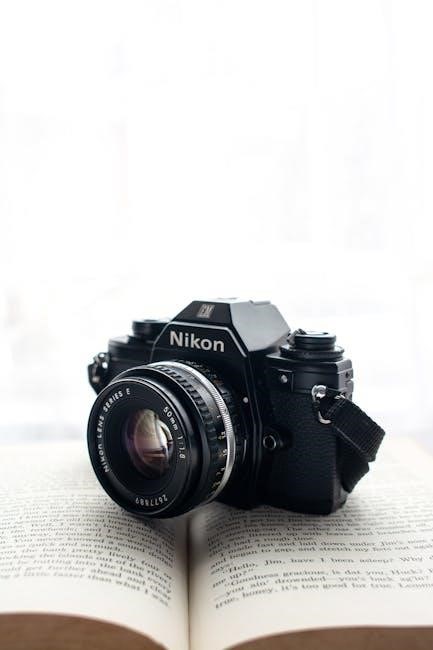
Manual focus, accessed via the lens focusing ring, offers precise control, particularly useful in low light or macro photography. Mastering both systems ensures optimal sharpness. Remember to check focus confirmation indicators for accurate results, enhancing image quality and creative intent.
Autofocus Modes – Single, Continuous, Dynamic Area
As of March 31st, 2026, the Nikon F100’s autofocus system offers three distinct modes. Single Autofocus (AF-S) locks focus once achieved, ideal for still subjects. Continuous Autofocus (AF-C) continuously adjusts focus, tracking moving subjects effectively. This is perfect for sports or wildlife photography.
Dynamic Area AF utilizes multiple focus points, allowing the camera to maintain focus even if the primary subject briefly moves. This mode provides a balance between precision and tracking ability. Selecting the appropriate mode depends on the subject’s movement and the desired outcome, ensuring sharp, well-focused images.
Manual Focus Operation
As of March 31st, 2026, the Nikon F100 allows precise manual focusing. Switch the focus mode selector on the lens to ‘M’. Rotate the focusing ring on the lens barrel to achieve sharpness, observing the image through the viewfinder. Utilize the split-image rangefinder in the center of the viewfinder for critical focus.
Fine-tune adjustments are crucial for optimal results. For distant subjects, small adjustments make significant differences. Remember to confirm focus before releasing the shutter. Manual focus is invaluable in low-light conditions or when autofocus struggles with low contrast or complex patterns, offering complete control over your image’s sharpness.
Metering System and Exposure Compensation
As of March 31st, 2026, the Nikon F100 boasts a sophisticated metering system. It offers Matrix, Center-Weighted, and Spot metering modes, selectable via the camera’s control panel. Matrix metering evaluates the entire scene for balanced exposure. Center-Weighted prioritizes the center of the frame, ideal for portraits. Spot metering measures light from a very small area, useful for challenging lighting.
Exposure compensation, adjustable in +/- steps, allows you to override the camera’s suggested exposure. Use it to brighten or darken images when the camera is fooled by bright or dark scenes, ensuring accurate and creative control over your photographs.
Metering Modes – Matrix, Center-Weighted, Spot
As of March 31st, 2026, understanding the Nikon F100’s metering modes is crucial for optimal results. Matrix metering analyzes the entire frame, providing balanced exposure for most situations. Center-weighted metering gives greater weight to the center of the image, excellent for portraits where subject brightness is key.
Spot metering measures light from a tiny area, ideal for challenging contrast or backlit scenes. Selecting the appropriate mode via the camera’s control panel ensures accurate exposure. Experiment with each mode to master their unique strengths and achieve your desired photographic style.
Using Exposure Compensation Effectively
As of March 31st, 2026, the Nikon F100’s exposure compensation feature allows fine-tuning of the camera’s automatic exposure settings. When the camera is fooled by bright or dark scenes, use +/- buttons to adjust. Positive values brighten the image, while negative values darken it.
This is particularly useful in snowy or backlit conditions. Remember to reset the compensation to zero after each adjustment to avoid unintended effects in subsequent shots. Practice using exposure compensation to gain control over your images and achieve consistently accurate exposures.
Advanced Features and Settings
As of March 31st, 2026, the Nikon F100 offers several advanced features for experienced photographers. Depth of Field Preview allows visualizing the area in focus at the selected aperture. The Multiple Exposure Function enables combining multiple images into a single frame, creating surreal effects.
The Self-Timer Operation provides a convenient way to include yourself in photos or avoid camera shake. Explore these settings to unlock the F100’s full potential and enhance your creative control. Remember to consult the full manual for detailed explanations and optimal usage.
Depth of Field Preview
As of March 31st, 2026, utilizing the Depth of Field Preview on your Nikon F100 is crucial for precise control over image sharpness. This function, accessible via a dedicated button, stops down the lens to the selected aperture, allowing you to visually assess the extent of focus before capturing the image.
This is particularly useful for landscape or macro photography where maximizing depth of field is essential. Observe the viewfinder to confirm sufficient sharpness throughout the desired area. Remember to release the preview button before shooting, as it darkens the viewfinder.
Multiple Exposure Function
As of March 31st, 2026, the Nikon F100’s Multiple Exposure function, a creative tool, allows superimposing multiple images onto a single frame. Activate this mode by engaging the dedicated control. Each subsequent exposure adds to the previous one, building layers of imagery.
Carefully consider your exposure settings for each shot to avoid overexposure. Utilize the rewind release to prevent accidental film advance between exposures. This feature is ideal for artistic effects, blending textures, or creating surreal compositions. Remember to return to normal shooting mode after completing your multiple exposure sequence.
Self-Timer Operation
As of March 31st, 2026, the Nikon F100’s self-timer function, a useful tool for group photos or avoiding camera shake, is activated via a dedicated control on the camera’s top panel. Select the desired delay – typically 10 seconds – before pressing the shutter button.
A blinking LED indicates the timer is active. Use this time to compose yourself in the frame. The shutter will release automatically after the selected delay. Remember to use a stable surface or tripod for optimal results, especially in low light. Deactivate the self-timer after use to prevent unexpected delays.
Troubleshooting Common Issues
As of March 31st, 2026, encountering issues with your Nikon F100 is normal. Common problems include error messages displayed on the LCD, often indicating film loading errors or battery issues. If an error occurs, consult the detailed error code list in this manual for specific solutions.
Basic maintenance, like cleaning the lens and mirror with appropriate tools, prevents dust accumulation. Ensure the battery compartment is free of corrosion. If problems persist, avoid attempting complex repairs yourself; seek professional assistance; Regular cleaning and careful handling will extend the life of your F100.
Error Messages and Solutions
As of March 31st, 2026, the Nikon F100 utilizes error messages to diagnose issues. “Err” flashing indicates a general malfunction – try resetting the camera. “Lo” on the battery indicator signifies low battery power; replace the batteries immediately. A blinking “F” suggests a film-related problem; re-load the film correctly, ensuring proper threading.
If the LCD displays a continuous error, consult the full error code list in the appendix of this manual. Avoid forcing any mechanism. If the issue persists after attempting these solutions, professional repair is recommended. Remember to always handle the camera with care to prevent further complications.
Basic Maintenance and Cleaning
As of March 31st, 2026, regular maintenance ensures your Nikon F100’s longevity. Gently blow away dust from the camera body and lens using a blower. Avoid using compressed air, which can damage components. Clean the viewfinder eyepiece and LCD screen with a soft, lint-free cloth.
Periodically check the battery compartment for corrosion. Store the camera in a dry, dust-free environment when not in use. Do not use solvents or abrasive cleaners. Professional cleaning of the internal mechanisms is recommended every few years to maintain optimal performance. Careful handling prevents unnecessary wear and tear.